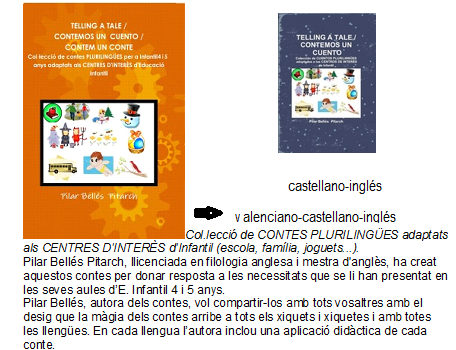
Introducción: TELLING A TALE / CONTEMOS UN CUENTO
Esta colección de cuentos os puede ser muy útil tanto a Educación Infantil como a especialistas de inglés dentro de vuestro trabajo dentro del Programa Plurilingüe de la LOE. TELLING A TALE / CONTEMOS UN CUENTO Autora: Pilar Bellés Pitarch Colección de cuentos plurilingües para Educación Infantil 4 y 5 años adaptados a los CENTROS DE INTERÉS de Educación Infantil: Escuela, familia, casa, Navidad y juguetes, el cuerpo y el invierno, la ropa, los alimentos, la Pascua, los animales, el verano y las vacaciones. DISPONIBLE EN FORMATO LIBRO: Distribuidora Bubok: http://pilarbellespitarch.bubok.com Distribuidora Lulu: http://stores.lulu.com/bellespitarchathotmaildotcom Otros títulos: 1. ¿Cómo hacer alumnos creativos? (Colección de cuentos plurilingües para desarrollar la creatividad y, a la vez, trabajar valores). Hay cuentos para cada nivel desde Infantil hasta tercer ciclo de Primaria. http://pbelles2.blogia.com/ 2. Cuentos plurilingües para trabajar valores y para días especiales (Día la paz, día del árbol, Halloween…). http://pilarbellespitarch2.blogia.com/ 3. No dejes que crezca sin la magia de los cuentos… según lo que quieras transmitir, elige un cuento y…cuéntaselo. (Colección de cuentos de otras publicaciones). http://bellespitarch2.blogia.com/ PROGRAMACIÓN LOE DE CUENTOS PLURILINGÜES OBJETIVOS: 1. Dar a conocer estos cuentos. (... continúa)
CUENTOS ADAPTADOS A LOS CENTROS DE INTERÉS DE EDUCACIÓN INFANTIL
1. Escuela / School:
Infantil 4:
The Little Sheep is Learning at School (p. 10).
La ovejita aprende en la escuela (p. 12).
Infantil 5:
What a Mess! What Can we Do? (p. 15).
¡Menudo desastre! ¿Qué hacemos ahora? (p. 16).
2. La familia y el otoño / Family and home:
Infantil 4:
Everybody Collaborates at Home (p. 20).
En casa todo el mundo colabora (p. 22).
Infantil 5:
The Little Elephant Can’t Sleep (p. 25).
El elefantito no puede dormir (p. 26).
3. La Navidad y los juguetes / Christmas and toys.
Infantil 4:
Charlie Has Got a New Toy (p. 29).
El nuevo juguete de Charlie (p. 31).
Infantil 5:
(... continúa)
LITTLE SHEEP IS LEARNING AT SCHOOL / LA OVEJITA APRENDE EL NOMBRE DE LAS COSAS

LITTLE SHEEP IS LEARNING AT SCHOOL
Didactic advice: We need cards with pictures: a sheep, a horse, a dog... pen, pencil, crayon, rubber, bag, chair, table, door… When you introduce vocabulary, you show cards. Students repeat the new words. All the class repeats the new words in chorus. Each time the sheep talks, students clap their hands. The teacher asks student for a pen, a pencil, a crayon, a rubber, glue, a bag, a chair, a table, a door…
Once upon a time there was a little sheep that went to school. She didn’t talk or know the names of everything. She wanted education and knowledge.
‘Hello!’ said the horse and the dog.
‘Baa!’ said Little Sheep.
The horse and the dog became very sad that day.
During the next days the sheep began to learn new words:
‘Look, Little Sheep, this is a pencil,’ said the teacher.
‘This is a pencil,’ repeated one student.
‘A pencil!’ repeated all the class in chorus.
‘A pencil!’ said the sheep.
Everybody became happy and clapped his / her hands.
‘Look, Little Sheep, this is a rubber,’ said the teacher.
‘This is a rubber,’ repeated another student.
‘A rubber!’ repeated all the class in chorus.
‘A rubber’ said the sheep.
Everybody smiled and clapped his / her hands.
‘Look, Little Sheep, these are papers, a pen, glue, crayons, a bag, a door, a chair...’
So, they repeated the words until Little Sheep could learn them.
One day Little Sheep lost her pencil.
‘Can I have a pencil?’
‘Yes,’ said one student and he gave her a pencil.
‘Thank you,’ said the sheep.
‘You are welcome,’ said the teacher.
‘Bye- bye,’ said the sheep when she went out.
‘Bye- bye,’ answered the students.
Other days Little Sheep asked for a rubber, a paper or the glue… and she was well-mannered.
LA OVEJITA APRENDE EL NOMBRE DE LAS COSAS
Consejos didácticos: Se puede usar este cuento como primera lengua o como segunda lengua si los niños y niñas tienen dominio oral de la lengua.
Usaremos las imágenes de la oveja, el caballo y el perro junto con todas las cosas de clase mencionadas: bolígrafo, lápiz, ceras, goma, pegamento, mochila, silla, mesa, puerta.
Cuando el alumno conoce oralmente la lengua del cuento no hacen falta tantas repeticiones como en inglés y se puede dejar que los alumnos intervengan el cuento añadiendo nuevas cosas de clase o para pedírselas por favor a sus compañeros.
Había una vez una ovejita que acudió a la escuela. No hablaba ni tampoco sabía el nombre de las cosas. Quería recibir educación y conocimiento.
—¡Hola! —le dijeron el caballo y el perro.
—¡Bee! —contestó la ovejita.
El caballo y el perro se pusieron muy tristes ese día.
En los días siguientes la ovejita empezó a aprender palabras nuevas.
—Mira, Ovejita, esto es un lápiz —decía la maestra.
Los compañeros y compañeras lo repetían, la ovejita lo aprendía, todos se ponían muy contentos y le aplaudían.
—Mira, Ovejita, esto es una goma —decía la maestra.
Lo repetían los compañeros y compañeras, luego lo aprendía la ovejita.
Todos se ponían muy contentos y aplaudían sus progresos.
—Mira, Ovejita, éstas son fichas, un bolígrafo, pegamentos, ceras, una mochila, una puerta, una silla…
Así se lo fueron repitiendo hasta que la ovejita lo pudo aprender.
Un día la ovejita perdió el lápiz.
—¿Puedo coger un lápiz?
—Sí —dijo un compañero y le dio el lápiz.
—Gracias —dijo la ovejita.
—No hay de qué —dijo la maestra.
—Adiós —se despidió la oveja al irse.
—Adiós —contestaron los compañeros y compañeras.
Así la ovejita aprendió a pedir las cosas y a despedirse con educación y fue acogida en un grupo de amigos y amigas.
WHAT A MESS! WHAT CAN WE DO NOW? / ¡MENUDO DESASTRE! ¿QUÉ HACEMOS AHORA?

WHAT A MESS! WHAT CAN WE DO NOW?
Didactic advice; First you should stick a picture like that above and cards on the board about classroom material (pencils, crayons, glues, scissors, papers, books, puzzles, paints, plasticine…) and also about animals (dog, cat, rabbit, dinosaur…). You can point to them during the story and make gestures.
Children at nursery school had got different trays to put pencils, crayons, glues, scissors, papers, books, puzzles, paints and lately plasticine…
One day children wanted to paint.
‘Can we paint?’
‘Yes, you can,’ said the teacher, ‘but you must be careful. Don’t paint on the tables.’
After painting, they cleaned everything.
Another day:
‘Can we make plasticine shapes?’
‘Yes, you can,’ said the teacher, ‘but you must be careful.’
Children made lots of plasticine shapes: dogs, cats, rabbits, dinosaurs… they had a nice time.
After making plasticine shapes, they looked down… there were small plasticine pieces stuck everywhere. The teacher got angry.
‘What a mess! How awful! What can we do?’
‘Plasticine must be punished!’ said one student.
‘We must clean,’ said another student.
‘OK,’ said the teacher.
All the students cleaned the tables and picked up the small pieces of plasticine stuck on the floor.
Next day, plasticine was punished in its box.
Days later they could make plasticine shapes, but when they made plasticine shapes they must be careful and they mustn’t leave small pieces stuck on the floor.
¡MENUDO DESASTRE! ¿QUÉ HACEMOS AHORA?
Consejos didácticos: La plastilina y las pinturas les encantan a los niños. Se lo pasan en grande experimentando. Detrás de su ilusión quedan descuidos de gotas de pintura en la ropa, muebles manchados, pinceles pegados por no limpiarlos bien… no dejemos que nuestra preocupación por el orden y la disciplina les amargue la diversión del momento… aunque, jamás podemos descuidar el orden ni la disciplina. ¿Cómo lo hacemos? Podemos probar con historias como ésta.
En este caso podemos dejar que los niños y niñas intervengan en detalles puntuales pero hemos de tener cuidado que no nos cambien el final… destrozarían la historia.
Además del dibujo podemos usar tarjetas pegadas sobre la pizarra de material de clase (lápices, colores, libros, puzzles, pinturas, plastilina, pegamentos, tijeras, fichas…) y también de animales (perro, gato, conejo, dinosaurio…). Las señalaremos a lo largo de la historia. Los niños pueden intervenir a la hora de enumerar cosas de clase que están en bandejas y para decir animales que les gustaría hacer con plastilina.
En la clase de infantil se guardaban en bandejas independientes sus lápices, colores, cola, tijeras, fichas de trabajo, libros, puzzles, pinturas y, últimamente, plastilina.
Algunos días, la seño dejaba pintar con los pinceles. Siempre les pedía antes que tuvieran mucho cuidado. Luego limpiaban entre todos. De esta manera, todo iba bien.
Los niños se emocionaron cuando vieron la plastilina.
—¿Podremos jugar con la plastilina?
—Sí, podéis —dijo la seño—, pero tened cuidado.
Ese día todos los niños y niñas hicieron mil formas de plastilina: perros, gatos, conejos, dinosaurios… se lo pasaron en grande.
Después de hacer tantas formas de plastilina, miraron al suelo. Había pegotes de plastilina por todas partes. La seño se enfadó.
—¡Menudo desastre! ¿Qué hacemos ahora? —dijo la seño.
—Debemos castigar a la plastilina —dijo un niño.
—Debemos limpiar —dijo una niña.
—Vale —dijo la seño.
Todos los niños y niñas limpiaron las mesas y rascaron los trozos pequeños de plastilina embadurnados al suelo.
Al día siguiente la plastilina estaba castigada sin salir de la caja.
Unos días después pudieron hacer más formas de plastilina pero debían de tener cuidado de no dejar caer pequeños trozos en el suelo.
En aquella clase, los niños y niñas disfrutaron de lo lindo con pinturas y plastilina casi a diario, siempre cumpliendo las normas.
Pasaron momentos inolvidables.
EVERYBODY COLLABORATES AT HOME / EN CASA TODO EL MUNDO COLABORA

EVERYBODY COLLABORATES AT HOME
Didactic advice: We need cards of a family of bears (Mum, Dad, brother, sister) cards of the house (kitchen, living-room, bathroom, bedroom, and dinning room) and we make gestures for activities (listen to music, watch TV, play with friends, read…). We point the cards during the story and students repeat the new words. We make gestures according to the story and students repeat them.
It was hot. The family of bears was taking a nap after lunch. Everybody was silent in order to sleep. (Teacher and students make gestures like they sleep).
“Can they sleep?”
“No, no, no… everybody is awake.”
“Can Mum sleep?” (Point to Mum in the pictures).
“No, no, no.” Mum was in the kitchen. (You point at Mum in the picture and make gestures of listening to music and a card of the kitchen). She wanted to listen to music but she couldn’t because everything must be quiet (make a gesture of silence).
“Can Dad sleep?”
“No, no, no.” Dad was in the living-room. He wanted to watch TV, but he couldn’t, (point to the cards of watching TV and the living room). Everything must be quiet (make gesture of silence).
“Can the brother and his sister sleep?”
“No, no, no”. The brother and his sister were in their bedroom. They wanted to play with their friends (point at a card of the bedroom and make gesture of children playing). But they couldn’t. Everything must be quiet (make a gesture of silence).
Suddenly the door bell rang. It was their neighbour. She wanted to leave their children because she must go to the doctor.
They wanted to play…
‘Hurray! Can we go to play, Mum?’
‘OK. Play in your bedroom. Don’t make noise.’
Finally the children could play with their friends in their bedroom (show the card) until they fell asleep.
Mum could listen to music (make gestures) and Dad could watch TV (make gestures).
Everybody was happy because everybody collaborated with the others at home.
EN CASA TODO EL MUNDO COLABORA
Consejos didácticos: Podemos usar tarjetas para señalarlas cuando contamos la historia. La de la familia de osos (mamá, papá, hermano, hermana), de las habitaciones (cocina, baño, dormitorio, comedor, salón) y actividades que se hacen en cada habitación de la casa (escuchar música, ver la tele, jugar con los amigos, leer), pediremos a los niños que nos digan más actividades que se hacen en cada habitación.
Cuando el niño conoce la lengua, no hacen falta tantas repeticiones ni gestos como con lengua extranjera, aunque les resulten divertidos. Podemos aprovechar para pedir la opinión a niño / niña sobre cómo continua o introducir valores a través del cuento. A veces, en casa nos toca aguantar a todos un poco para que los demás sean felices. Hemos de tener paciencia si alguna vez no podemos hacer lo que quisiéramos… hay que colaborar al bien de todos.
Hacía calor. La familia de osos estaba haciendo una siesta después de comer. Todo el mundo estaba en silencio para que el resto de la familia pudiera dormir.
“¿Tú crees que podían dormir?”. (Preguntamos a los niños).
“No, todos estaban despiertos” (nos responden).
“¿Qué estaría pensando mamá?”.
Mamá estaba en la cocina. Le hubiera gustado escuchar música… pero no podía porque se tenía que guardar silencio.
“¿Qué estaría pensando papá?”
Papá estaba en el salón. Le hubiera gustado ver la tele… pero no podía porque todo estaba en silencio.
“¿Qué estarían pensando los pequeños ositos?”
Los pequeños estaban en su habitación. Les hubiera gustado jugar con sus amigos pero no podían, todo estaba en silencio…
De repente, sonó el timbre de la puerta. Era la vecina que dejaba los niños porque se tenía que ir al médico.
—¡Bien!… ¿Podemos ir a jugar?
—¡Vale! Jugad a vuestra habitación y no hagáis ruido.
Finalmente los pequeños pudieron jugar con sus amigos hasta que cayeron rendidos y se durmieron.
Una vez dormidos, mamá pudo escuchar música y papá pudo ver la televisión.
En casa todos hemos de colaborar para que podamos ser felices.
THE LITTLE ELEPHANT CAN’T SLEEP / EL ELEFANTITO NO PUEDE DORMIR

THE LITTLE ELEPHANT CAN’T SLEEP
Didactic advice: We need cards of the members of the family (Mum, Dad, brother, sister, Granny and Grandad) and house (bedroom, bathroom, kitchen, dinning-room, living room). You point to the cards and make gestures according to the story.
It was time to take a nap. The little elephant wanted to sleep but he couldn’t. He went to Mum and Dad’s bedroom.
‘Can I stay here?’
‘Yes, you can, but you have to sleep.’
They played in bed. Mum and Dad tried to make the little elephant sleep. He wanted to play with Mum and Dad.
Everyday they played until sleep overcame him. But that day they couldn’t.
The little elephant went to his sister bedroom.
‘Can I stay here?’
‘Yes, you can… but you have to sleep.’
The brother and his sister played together, but he couldn’t sleep there.
The little elephant went to the bathroom but it was too cold to sleep (point to the bathroom, shake your head and make gestures of cold).
Then he went to the kitchen but it was too small to sleep (point and make gestures).
Then he went to the dinning-room but it was too big to sleep (point and make gestures).
Finally the little elephant went to the living room where Granny and Granddad were on the sofa. They were watching TV.
‘Can I watch TV with you?’
‘OK,’ said Granny.
Ten minutes later the little elephant fell asleep. Finally the little elephant could sleep (make gestures of being asleep).
EL ELEFANTITO NO PUEDE DORMIR
Consejos didácticos: Las repeticiones son útiles aunque se pueden usar con moderación, sirven para introducir vocabulario y hacer que los niños y niñas sigan fácilmente la historia. Cuanto más conocen la lengua se hacen menos gestos y se usan más palabras. Se pueden usar imágenes y gestos. Los niños y niñas nos dirán habitaciones que se pueden encontrar en una casa.
Era la hora de dormir. El elefantito quería dormir pero no podía.
Fue a la habitación de papá y mamá.
—¿Puedo quedarme aquí?
—Sí, puedes… pero debes dormir.
Se puso a jugar en la cama de sus padres. Papá y mamá trataron de dormirlo.
Cada día jugaban hasta que el sueño se apoderaba de él. Pero ese día el elefantito no podía dormir.
El elefantito se fue a la habitación de su hermana.
—¿Puedo quedarme aquí?
—Sí, puedes… pero debes dormir…
El elefantito jugó un rato allí pero tampoco pudo dormir.
Fue al baño pero hacía demasiado frío para dormir (señalamos el baño, hacemos gesto de frío y decimos que no con la cabeza).
Fue a la cocina pero era demasiado pequeña para dormir (señalamos y gesticulamos).
Entonces fue al comedor pero era demasiado grande para dormir (señalamos y gesticulamos).
Finalmente el elefantito fue al salón donde los abuelos estaban mirando la televisión.
—¿Puedo ver la televisión con vosotros?
—Vale.
Diez minutos después el elefantito se había quedado dormido… por fin el pequeño elefante se pudo dormir.
“¡Que descanses elefantito!”
CHARLIE HAS GOT A NEW TOY/ EL NUEVO JUGUETE DE CHARLIE

CHARLIE HAS GOT A NEW TOY
Didactic advice: We need cards of toys (car, ball, drum, kite, balloon, train, boat, teddy bear…) and a picture of two boys playing together. You can point them during the story. Students repeat the new words.
Once upon a time there was a small boy called Charlie. He was very proud of his toys.
He had got lots of cars and a car parking, a ball, a drum, a kite, a balloon, a train, a boat… but his favourite toy was his teddy bear (you point to the toys and students repeat their names too).
The day after Christmas holiday, the teacher asked students to bring a toy to school to share with their partners.
Charlie took his teddy bear, but when he arrived at school…
‘Can I have your teddy bear?’ asked one partner. ‘Then you can have my toy.’
‘No, no, no… it’s mine.’
‘Please!’
‘No, no, no. Go away!’
Charlie was having a nice time with his new toy but the other student became sad.
Some time later Charlie began to get bored with his toy and he wanted to change it.
‘No, no, no’ said the other children.
‘Please!’
‘No, no, no. Go away.’
Charlie became very sad. It had been his fault.
Charlie looked for the boy who wanted to share his toy with him to ask him for forgiveness.
‘I’m sorry,’ said Charlie.
‘It’s OK,’ said the other boy.
‘Can we play together?’
‘OK.’
‘Thank you.’
‘You are welcome.’
They became friends and shared out their toys with other students. It was amusing!
EL NUEVO JUGUETE DE CHARLIE
Consejos didácticos: Cuando decimos el nombre de los juguetes podemos dejar intervenir a los niños para que digan el nombre de otros juguetes que conocen. Cuando Charlie decide escoger su osito como su juguete favorito, podemos preguntar a nuestros pequeños cuál es su juguete favorito… dejar que se identifiquen con la historia.
Había una vez un niño llamado Charlie. Él estaba muy orgulloso de todos sus juguetes.
Tenía muchos coches en un parking, un balón, un tambor, una cometa, un globo, un tren, un barco… (Dejamos que los niños digan otros) pero su juguete favorito era su osito de peluche.
A la vuelta de las vacaciones de Navidad el profesor pidió a los niños y niñas que trajeran un juguete para compartirlo con sus compañeros y compañeras.
“¿Qué juguete hubieras escogido tú?” (Intervienen los niños /las niñas por turno).
El pequeño Charlie se trajo su osito. Al llegar a clase…
—¿Me puedes dejar el osito? — le preguntó un compañero—, yo te dejaré mi juguete…
—No, no, no… es mío.
—¡Por favor!
—No, no, no… ¡vete!
Charlie se lo estaba pasando en grande con su juguete nuevo pero el otro niño se puso muy triste.
Pasó el tiempo y Charlie comenzó a aburrirse de su juguete y quiso cambiárselo a otros niños.
—No, no, no —le dijeron.
—¡Por favor!
—No, no, no… ¡vete!
Charlie se puso muy triste… todo había sido culpa suya.
Buscó al niño de antes que le había pedido compartir su juguete y le pidió perdón.
—Lo siento —le dijo Charlie.
—No pasa nada —contestó el otro.
—¿Podemos jugar?
—Vale.
—Gracias.
—De nada.
Los dos niños se hicieron amigos y compartieron sus juguetes con otros niños.
¡Resultó ser divertido!